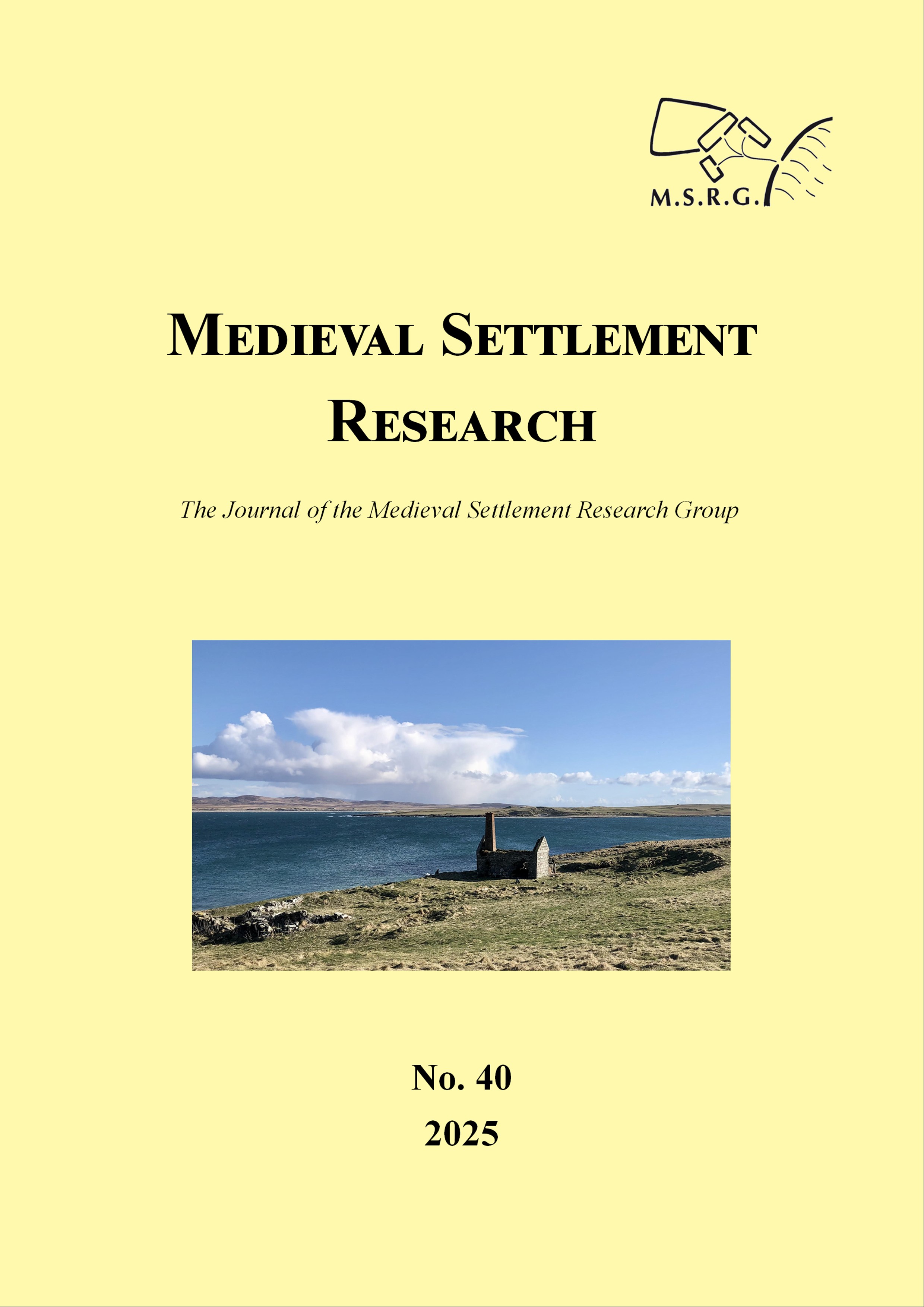
Inhabiting the Inner Hebrides: exploring settlement and marginality on the Isle of Islay, Scotland
Keywords:
medieval, Islay, Hebrides, ScotlandAbstract
The concept of marginality within archaeological research has been much debated over recent years, with current thought placing a greater emphasis on the inter-relationship of environmental, economic and social systems. This article explores two former medieval and later settlements and their farming-districts on the Isle of Islay, Scotland, UK, both occupying landscapes that could today be considered marginal. It uses new archaeological data to look at how these farming communities adapted and changed over time in response to evolving political, socio-economic and environmental circumstances. It reaches the conclusion that marginality is inherently fluid, with landscapes not viewed as marginal by one group becoming marginal to another as environmental and economic systems change, and political and cultural practices evolve.
References
Alcock, L. and Alcock, E. 1980. Scandinavian settlement in the Inner Hebrides: Recent research on place names and in the field. Scottish Archaeological Forum 10: 61–73.
Armit, I. 1998. Human responses to marginality. In C. M. Mills and G. Coles (eds), Life on the Edge. Oxford: Oxbow Books, 31–38.
Barrett, J.H. 2016. Medieval Sea Fishing, AD 500–1550: Chronology, Causes and Consequences. In J.H. Barrett and D.C. Orton (eds), Cod and Herring: The Archaeology and History of Medieval Sea Fishing. Oxford: Oxbow Books, 250–271.
Bond, J.M., Outram, Z. and Freeth, C.M. (eds) 2008. Viking Unst Project. Excavations at Hamar and the Upper House, Underhoull: Field Season 2008. Interim Report No. 2 (Data Structure Report). Bradford Archaeological Sciences Research 20. Bradford: Department of Archaeological Sciences/Shetland Amenity Trust.
Breen, C. 2019. Maritime connections: Landscape and lordship along the Gaelic Atlantic seaboard of Scotland and the north of Ireland during the Middle Ages. Journal of the North Atlantic 12: 3–15.
British Geological Survey, 2022. Geology of Britain. Islay, Argyll & Bute. [http://mapapps.bgs.ac.uk/geologyofbritain/home.html/]. Accessed 21/04/2022.
Brown, H., and Adams, C. 2022. Geophysical Survey Report: Nave Island, Isle of Islay. Bradford: Magnitude Surveys.
Caldwell, D.H. 2008. Islay: Land of the Lordship. Edinburgh: Birlinn.
Caldwell, D.H. 2011. Islay, Jura and Colonsay: A Historical Guide. Edinburgh: Birlinn.
Caldwell, D.H. and Ewart, G. 1993. Finlaggan and the Lordship of the Isles: An Archaeological Approach. The Scottish Historical Review 72.194, Part 2: 146–166.
Caldwell, D.H.R., McWee, R. and Ruckley, N.A. 1999. Nave Island, Islay (Kilchoman parish), ?cross shaft; barrel-shaped house. Discovery and Excavation Scotland 1999: 17.
Coles, C.M. and Mills, G. 1998. Clinging on for grim life: an introduction to marginality as an archaeological issue. In C.M. Mills and G. Coles (eds), Life on the Edge. Oxford: Oxbow Books, vii–xii.
Costello, E. 2021. The Colonisation of Uplands in Medieval Britain and Ireland: Climate, Agriculture and Environmental Adaptation. Medieval Archaeology 65.1: 151–179. DOI: https://doi.org/10.1080/00766097.2020.1826123.
Costello, E., Kearney, K. and Gearey, B. 2023. Adapting to the Little Ice Age in pastoral regions: An interdisciplinary approach to climate history in north-west Europe. Historical Methods: A Journal of Quantitative and Interdisciplinary History 56.2: 77–96. DOI: https://doi.org/10.1080/01615440.2022.2156958
Dalglish, C. 2012. Scotland’s Medieval Countryside: Evidence, Interpretation, Perception. In N. Christie and P. Stamper (eds), Medieval Rural Settlement: Britain and Ireland, AD 800-1600. Oxford: Oxbow Books, 270–289.
Dixon, P. 2016. Mukked and folded land: The evidence of field data for medieval cultivation techniques in Scotland. In J. Klápste (ed.), Agrarian technology in the Medieval landscape. Turnhout: Brepols, 107–123.
Dodgshon, R. 1993. West Highland and Hebridean settlement prior to crofting and the Clearances: a study in stability or change? Proceedings of the Society of Antiquaries of Scotland 123: 419–438.
Gray, M. 1951. The Kelp Industry in the High-Lands and Islands. The Economic History Review new ser. 4.2: 197–209.
Halliday, S. 2003. Rig-and-furrow in Scotland. In S. Govan (ed.), Medieval or Later Rural Settlement in Scotland: 10 Years On. Edinburgh: Historic Scotland, 69–82.
Jamieson, E., Pearson, T. and Clarke, A. 2022a. Medieval and Later Settlement on the Island of Islay: Archaeological Survey and Excavation at the Township of Olistadh. Unpublished Research Report, University of Reading.
Jamieson, E., Adams, C. and Mithen, S. 2022b. Archaeological Survey of a Proposed ‘Viking house’ on Nave Island, Islay. Unpublished Research Report, University of Reading.
Kylander, M.E., Söderlindh, J., Schenk, F., Gyllencreutz, R., Rydberg, J., Bindler, R., Martínez Cortizas, A. and Skelton, A. 2020. It’s in your glass: a history of sea level and storminess from the Laphroaig bog, Islay (south-western Scotland). Boreas 49.1: 152–167.
Lamont, W.D. 1959–60. The Islay Charter of 1408. Proceedings of the Royal Irish Academy: Archaeology, Culture, History, Literature 60: 163–187.
MacLaren, A. 1974. A Norse house on Drimore Machair, South Uist. Glasgow Archaeological Journal 3: 9–18.
Macniven, A. 2013. ‘Borgs’, Boats and the Beginnings of Islay’s Medieval Parish Network? Northern Studies 45: 68–99.
Macniven, A. 2015. The Vikings in Islay: The Place of Names in Hebridean Settlement History. Edinburgh: Birlinn.
Maričević, D. 2020. Dunyvaig and Hinterland Assessment Project: Archaeological evaluation, survey and geophysical survey at Dunyvaig Castle and Cill Mhoire, Lagavulin, Islay. Unpublished Research Report, University of Reading.
Mithen, S.J. 2021. Land of the Ilich: Journeys into Islay’s Past. Edinburgh: Birlinn
Munro, R.W. (ed.) 1961. Monro’s Western Isles of Scotland and Genealogies of the Clans 1549. Edinburgh & London: Oliver and Boyd.
O’Sullivan, A., McCormick F., Kerr, T. and Harney, L. 2013. Early Medieval Ireland, AD 400-1100: The evidence from archaeological excavations. Dublin: Royal Irish Academy.
Parker Pearson, M., Brennand, M., Mulville, J. and Smith, H. 2018. Cille Pheadir: A Norse Farmstead and Pictish Burial Cairn in South Uist. Oxford: Oxbow Books.
Radford, C.A.R. 1959. The early Christian and Norse settlements at Birsay. Edinburgh: H.M.S.O.
RCAHMS 1984. Argyll Volume 5: Islay, Jura, Colonsay and Oronsay. London: H.M.S.O.
Sharples, N. (ed.) 2020. A Norse Settlement in the Outer Hebrides: Excavations on Mounds 2 and 2A, Bornais, South Uist. Oxford: Oxbow Books.
Sharples, N.M. and Parker Pearson, M. 1999. Norse settlement on the Outer Hebrides. Norwegian Archaeological Review 32: 41–62.
Small, A. 1966. Excavations at Underhoull, Unst, Shetland. Proceedings of the Society of Antiquaries Scotland 98: 225–248.
Smith, G.G. (ed.) 1895. The Book of Islay. Documents illustrating the history of the Island. Edinburgh: Neill and Co.
Soil Survey of Scotland 1981. Soil maps of Scotland at a scale of 1:250 000. Macaulay Institute for Soil Research, Aberdeen. DOI: https://doi.org/10.5281/zenodo.4646891.
Stevenson, J.B. 1985. The excavation of a hut circle at Cul a’Bhaile’, Jura. Proceedings of the Society of Antiquaries of Scotland 114: 127–160. DOI: https://doi.org/10.9750/PSAS.114.127.160.
Waters, G. 2013. The Drystone Chapels of Islay: Aspects of Chronology, Context and Distribution. Unpublished MPhil Thesis, University of Edinburgh.